Free trial

For a Limited Time — Try it Free for Two Weeks

Full access. Card required. Starting at $149/mo. after trial. Cancel anytime.

Start Free Trial

The most thoroughly sourced AI, data, privacy, and cybersecurity legal intelligence available.

2,800+ sources verifiedAll 50 states + D.C. + FederalAttorney-reviewed1,249+ legal developments since Jan. 1, 2026

Tracking all new major AI, data, privacy, and cybersecurity legal developments for you.

No noise. No gaps. Just the intelligence attorneys need.

Plans starting at $149/mo. No commitment required.

Built by an Attorney. Reviewed by an Attorney. Built for Attorneys.

Inside your workspace

docketdaily.ai/dashboard
Live data
Proposed Bills520
Statutes63
Regulations112
Cases71
Exec. orders34
Search titles, summaries, citations…
All Dates

Jan. 1, 2026 through today (newest to oldest)

Notable Dockets of the Week

GOVERNOR EXECUTIVE ORDER

Virginia Executive Order 30 (2024) — Implementation of Standards for the Safe Use of Artificial Intelligence Across the Commonwealth

VirginiaAI — Government use of AIJan 18, 2024
AI lawVirginia EO 30 establishes baseline standards for the responsible, ethical, and transparent use of AI by state government. It directs the Virginia IT Agency (VITA) to publish binding AI Policy Standards and AI IT Standards for all executive-branch agencies — a mandatory approval process for agency…
AI-drafted · Attorney-reviewed

More from the digest

REGULATIONAttorney Reviewed

Cybersecurity and Infrastructure Security Agency — Addition of One Known Exploited Vulnerability to the KEV Catalog (June 16, 2026): CVE-2026-48907 (Widget Factory Joomla Content Editor)

FederalCyber — Incident reporting & CIRCIAJun 16, 2026

Summary

Cybersecurity lawOn June 16, 2026, CISA added one actively exploited vulnerability to its Known Exploited Vulnerabilities (KEV) Catalog: CVE-2026-48907, an improper access control flaw in the Widget Factory Joomla Content Editor (JCE), a content-editor extension for the Joomla CMS. The vulnerability allows the uplo…
AI-drafted · Attorney-reviewed
STATUTEAttorney Reviewed

Vermont H.211 (2026) — An Act Relating to Data Brokers and Personal Information (Act 138)

VermontData — Data brokers & commercial saleJun 16, 2026

Summary

Data lawOn June 16, 2026, Governor Phil Scott signed Vermont H.211 (Act 138), overhauling Vermont's pioneering data-broker law. The act broadens the definition of "data broker," narrows when a "direct relationship" exists (pulling more businesses into scope), adds an affiliate carve-out from the definition…
AI-drafted · Attorney-reviewed
PROPOSED BILLActive

Maryland SB0025 / Buy Maryland Cybersecurity Tax Credit — Income Tax Credit; Annual Cap Increase to $1,000,000; Refundable Credit; January 1, 2031 Sunset

MarylandCyber — Cyber governance & policyJan 21, 2026

Summary

Cybersecurity lawMaryland SB0025, the Buy Maryland Cybersecurity Tax Credit bill cross-filed with HB0290, expands the existing program by raising the annual aggregate credit cap from $200,000 to $1,000,000 for businesses and nonprofits that purchase cybersecurity technologies or services from Maryland companies. Th…
AI-drafted · Attorney-reviewed
COURT CASEAttorney Reviewed

Granados v. Madison Square Garden Entertainment Corporation

New YorkU.S. District Court for the Southern District of New YorkAI — Algorithmic accountabilityJun 17, 2026

Summary

AI lawThe exposed materials reportedly include algorithmic facial-recognition matches and automated "risk" classifications of individuals generated by MSG's surveillance systems, raising concerns about automated profiling and the security of biometric-derived outputs.
AI-drafted · Attorney-reviewed
docketdaily.ai/dashboard
Live data
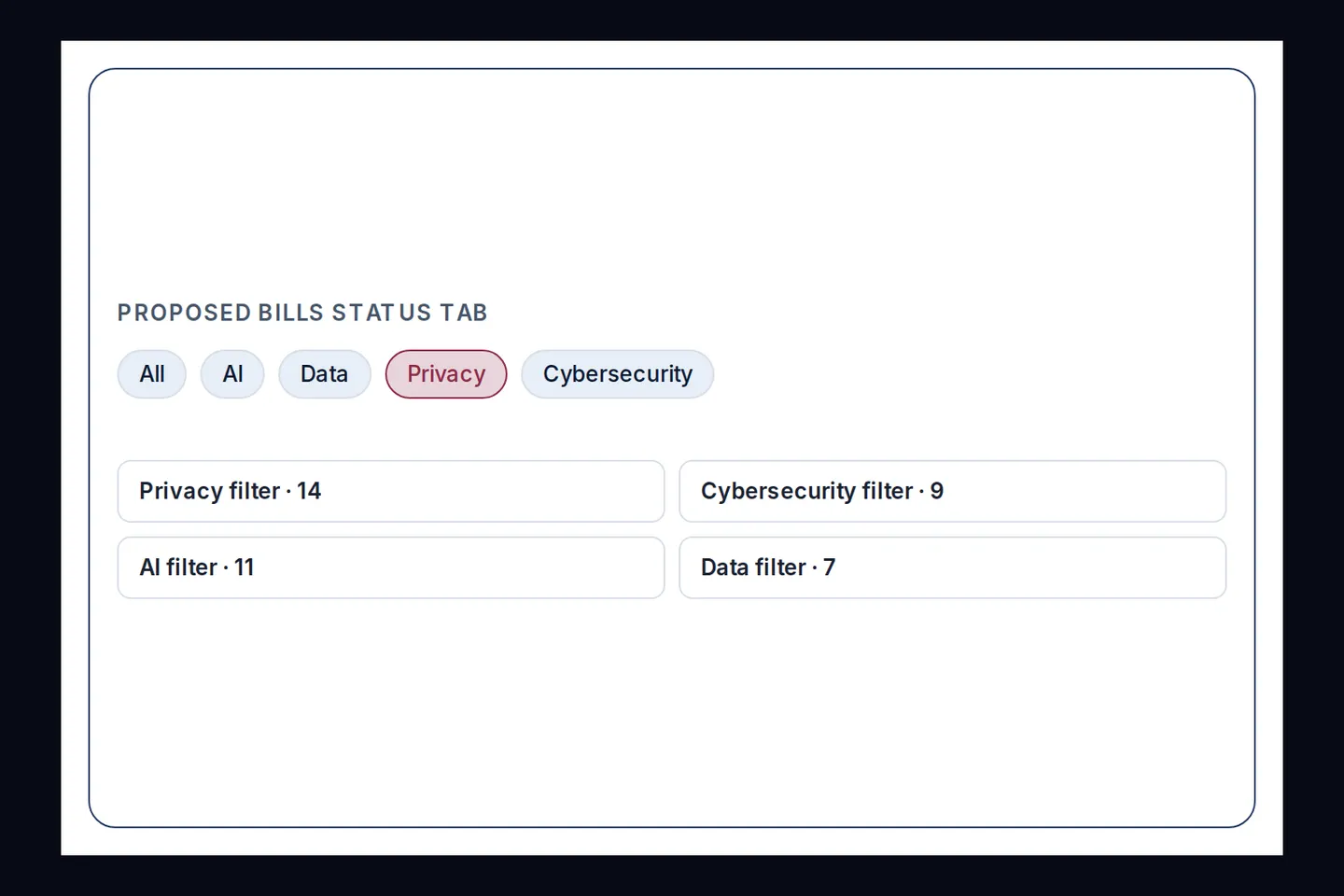
Filters & scope
AIArtificial intelligence
286
DataData
166
PrivacyPrivacy
261
CyberCybersecurity
78

The digests under each category are attorney reviewed and confirmed. You can view results by category as well as by subcategory under each law category.

Jurisdiction

Federal
State

Search

Search titles, summaries, citations…
GOVERNOR EXECUTIVE ORDER

Virginia Executive Order 30 (2024) — Implementation of Standards for the Safe Use of Artificial Intelligence Across the Commonwealth

VirginiaGovernor Executive OrderEO 30AI — Government use of AIJan 18, 2024

Summary

AI lawVirginia EO 30 establishes baseline standards for the responsible, ethical, and transparent use of AI by state government. It directs the Virginia IT Agency (VITA) to publish binding AI Policy Standards and AI IT Standards for all executive-branch agencies — a mandatory approval process for agency…
AI-drafted · Attorney-reviewed
docketdaily.ai/dashboard
Live data
REGULATIONAttorney ReviewedFederalCyber — Incident reporting & CIRCIA

Cybersecurity and Infrastructure Security Agency — Addition of One Known Exploited Vulnerability to the KEV Catalog (June 16, 2026): CVE-2026-48907 (Widget Factory Joomla Content Editor)

Plain English

Cybersecurity law

On June 16, 2026, CISA added one actively exploited vulnerability to its Known Exploited Vulnerabilities (KEV) Catalog: CVE-2026-48907, an improper access control flaw in the Widget Factory Joomla Content Editor (JCE), a content-editor extension for the Joomla CMS. The vulnerability allows the upload and execution of PHP code through the creation of new editor profiles for unauthenticated users, enabling remote code execution on affected sites. Listing in the KEV Catalog reflects evidence of active exploitation in the wild and triggers binding remediation obligations for Federal Civilian Executive Branch (FCEB) agencies, while serving as a priority-patching signal for private industry; the JCE developer has issued a security update and patch. Under Binding Operational Directive (BOD) 26-04, which updates BOD 22-01, federal agencies must rapidly remediate KEV-listed vulnerabilities on publicly exposed assets within the catalog's prescribed timelines, follow BOD 26-04 cloud-service guidance, or discontinue use of the product where mitigations are unavailable.

Contextual review

Cybersecurity law

CISA KEV Catalog addition issued June 16, 2026, adding CVE-2026-48907 (Widget Factory Joomla Content Editor — improper access control; unauthenticated creation of editor profiles permitting upload/execution of PHP code / remote code execution). The catalog operates under Binding Operational Directive (BOD) 26-04, "Prioritizing Security Updates Based on Risk," which updates and reinforces the BOD 22-01 framework and requires Federal Civilian Executive Branch agencies to remediate KEV-listed CVEs on publicly exposed assets per the directive's deadlines (or follow cloud-service guidance / discontinue the product if mitigations are unavailable). Authority derives from 44 U.S.C. ch. 35 (FISMA) and 6 U.S.C. § 659. Recorded as guidance; operative compliance obligation flows from BOD 26-04 as a binding directive on FCEB agencies. Cross-references: JCE vendor advisory (joomlacontenteditor.net) and NVD record (nvd.nist.gov/vuln/detail/CVE-2026-48907).

AI-drafted · Attorney-reviewed

Always verify this source before using it or citing it in legal work

Why law firms and in-house counsel use Docket Daily

  • Answer client and pitch questions faster

    See what changed in your focus areas without manually checking dozens of sources each morning.

  • One place for federal and state developments

    Follow the jurisdictions you care about in one workspace. Each digest entry is attorney-reviewed.

  • Prioritize what deserves your time

    Surface high-signal items so your team spends less time sorting noise and more time on analysis.

  • Support proactive compliance and risk narratives

    Align technical, privacy, and security teams with a shared view of the legal environment.

Bradley J. Martineau

Founder

Built by an Attorney

Bradley J. Martineau · Pennsylvania Attorney · AI Governance Author

Docket Daily was built by an attorney who lived the problem firsthand. Brad is a Pennsylvania-licensed lawyer, Amazon best-selling AI governance author, and the only person in legal tech who built this platform because no adequate tool existed. Every design decision comes from real legal and AI governance experience — not engineering assumptions.

“You're already paying for the library. Docket Daily is the attorney who researches and reads everything overnight and has the well-organized briefing ready when you arrive.” — Bradley J. Martineau, Founder & Attorney
  • 📘 The AI-Enabled Executive
  • 📗 Operational AI Governance
  • ⚖️ Pennsylvania Bar licensed

Included with every plan

Weekly Intelligence Brief

A structured Tuesday briefing — Top 5 scored highlights, trending states, and every qualifying federal and state development from the past seven days, organized by instrument type and jurisdiction.

  • Top 5 Laws of the Weekscored using the Docket Daily Relevance Scorecard, with plain-English narrative and direct links
  • Trending States in AI Lawwhich states drove the most activity during the coverage period
  • Federal developments (Part I)proposed bills, enacted statutes, regulations, SCOTUS, circuit and district courts, and presidential/agency actions
  • State developments (Part II)proposed bills, enacted statutes, regulations, appellate and supreme court cases, governor executive orders, and AG actions — organized by state
  • Key takeaways, action items, and watch listweek-at-a-glance analysis, items requiring immediate attention, and developments to monitor in the period ahead

Published each Tuesday by email. Included with Essential, Professional, and Enterprise plans.

Versus general-purpose AI

Why not just ask an AI chatbot?

General AI tools like ChatGPT and Claude are powerful, but they can't do what Docket Daily does.

  • No real-time awareness. AI chatbots have knowledge cutoffs and no access to bills introduced yesterday, rulings issued this morning, or executive orders signed this week.

  • No daily source coverage. Replicating Docket Daily manually means checking hundreds of sources daily. All 50 state legislatures, Congress, the Federal Register, federal and state courts, and all 50 governors' offices. Nobody does it as comprehensively.

  • Citation hallucination risk. Studies show leading legal AI tools hallucinate citations up to 33% of the time. Every Docket Daily entry links directly to the verified official government source.

  • No structured intelligence. A chatbot returns a wall of text. Docket Daily gives you a searchable, filterable brief with attorney-confirmed pillar tags, jurisdiction, and quality signals—ready for client briefings.

Docket Daily doesn't compete with AI. It pairs carefully crafted automation with verified government sources and attorney review that confirms how each item maps to AI, Data, Privacy, and Cybersecurity law plus safeguards a general chatbot was never built to offer.

Already have Westlaw? LexisNexis? Harvey?

Those are research tools.Docket Daily is a monitoring platform.

When you run a keyword alert on Westlaw or LexisNexis, you are still doing the work and deciding what to search, building the right query, and reading every result to separate signal from noise. Alerts fire on whatever their crawlers index, which is far weaker for state administrative rulemaking, governor executive orders, and proposed legislation than it is for published case law. The fatal flaw of keyword alerts is unknown unknowns.

Harvey is in a different category entirely. Harvey answers questions you ask. Docket Daily surfaces what you need to know before you know you need it. Reactive research and proactive monitoring are fundamentally different jobs.

  • Westlaw · LexisNexis · Bloomberg

    A library. The best research tools ever built — for looking things up when you have a question. Not built for watching.

  • Harvey · ChatGPT · Perplexity

    AI research assistants. Brilliant at answering questions you ask. Silent on everything you didn't know to ask about.

  • Docket Daily

    Proactive legal intelligence. 2,800+ sources. All 50 states, D.C. & Federal. All attorney-reviewed.

What you get

Curated legal coverage

A focused stream of new proposed bills, statutes, regulations, court opinions, and executive orders (all 50 states, D.C., and federal). attorney confirmed.

Federal & state legislation

Proposed bills and laws surfaced through structured and attorney trained AI agents that ingest from official governmental sources and are scoped to the four legal pillars Docket Daily covers.

Regulatory developments

Federal Register final rules, proposed rules, and NPRMs, plus direct monitoring of CISA (KEV, Directives, Advisories), FTC enforcement orders, OMB memoranda, NIST AI and cybersecurity publications, SEC cybersecurity enforcement, HHS/OCR HIPAA settlements, TSA Security Directives, FDA AI/ML medical device guidance, and DOJ data security program publications. State regulatory coverage includes the California Privacy Protection Agency (CPPA), New York DFS, and NAIC alongside 50-state AG enforcement actions.

Court opinions

Recent opinions from the U.S. Supreme Court, every federal circuit, every federal district court, and U.S. Bankruptcy Courts, plus every state supreme and appellate court opinion.

Executive orders

Presidential executive orders and Governor executive orders from all 50 states.

Search, filters & digest views

Find instruments quickly by term search, jurisdiction, and/or law category.

Human attorney confirmation on every entry

Before anything reaches a subscriber's digest, an attorney reviews each entry while automated passes and attorney-written and trained criteria narrow the funnel first.

Summaries & structured fields

After pillar placement is attorney-confirmed, then Plain English and Contextual Summaries are written for each applicable pillar - AI, Data, Privacy, and Cybersecurity.

Export-Ready Intelligence

Professional and Enterprise subscribers can export full PDF summaries by practice area or individual entry.

Team-ready access

Subscription and account tools suitable for small teams through larger groups with shared access models.

AI, data, privacy, & cybersecurity in the News

Headlines and links from a leading news outlet on AI, Data, Privacy, and Cybersecurity giving you the up to date news context to pair with the primary legal sources.

What We Track

  • AI Law

    • Mandatory disclosure and transparency requirements for AI systems used in consequential decisions
    • Algorithmic impact assessment and bias audit obligations
    • Human oversight mandates for AI in healthcare, insurance, employment, and benefits
    • Frontier model safety reporting and incident disclosure requirements
    • Prohibitions on AI-generated deepfakes, synthetic media, and nudification technology
    • Chatbot safety standards, professional service restrictions, and minor protections
  • Privacy Law

    • Comprehensive consumer data privacy frameworks — consumer rights, controller obligations, enforcement
    • Sensitive data protections for health, biometric, geolocation, reproductive, and children's data
    • Age-appropriate design codes and children's online privacy requirements
    • Workplace monitoring disclosure and employee data rights
    • Data broker registration, disclosure, and opt-out obligations
    • Geofence and reverse location warrant prohibitions
  • Data Law

    • Data lifecycle governance — collection minimization, retention limits, mandatory deletion
    • Government data practices and state agency data management standards
    • Cross-border data transfer restrictions and jurisdictional data sovereignty rules
    • Data protection impact assessment requirements for high-risk processing
    • Consumer portability, correction, and deletion rights enforcement frameworks
  • Cybersecurity Law

    • Data breach notification — timing, scope, AG and consumer notification mandates
    • Private sector cybersecurity standards — NIST framework adoption, written security programs
    • State and local government cybersecurity standards and incident response obligations
    • Insurance sector cybersecurity regulation under NAIC model law frameworks
    • Critical infrastructure protection obligations and sector-specific security requirements
    • Vendor and third-party security contracting mandates

Docket Daily tracks governance, compliance, and regulatory law. The rules that determine what organizations must do, disclose, and avoid when building and deploying technology. We monitor proposed legislation, enacted statutes, administrative regulations, executive orders, and court decisions that create legal obligations for businesses, government agencies, and technology developers. We do NOT track general criminal enforcement actions, routine civil litigation, or court decisions where technology appears incidentally in an otherwise unrelated legal matter.

SEE IT IN ACTION

Watch Docket Daily in Action

Preview still from the Docket Daily promotional video.

Ready to brief smarter?